294, 295, 296
- m60yicp2
- Dec 20, 2021
- 2 min read
294
From 1950s to 1990s, if you commuted (to/from your office, factory or school) by bus every day, you must remember to buy yuepiao (月票, monthly bus pass) of the next month in the last few days of this month.
A yuepiao was a paper card the size of a cigarette box. On a yuepiao, there were your bare-headed black-and-white photo and a small sticker with a big number indicating the month, for example, 7 (July).
There were two Chinese characters next to the number indicating the type of yuepiao. For example, shiqu (市区) meant that you could take the buses within the city, and couldn't take the buses to the suburbs.
Since 2000s, yuepiao was abolished, and gongjiaoka (公交卡,bus card containing integrated circuit chips, similar to credit card) was used. To this day, people are still using this kind of card.

295
During 50 years from 1950s to 1990s, the government did not allow the people to leave China, unless you had a special reason, for example, your mother in the United States was critically ill.
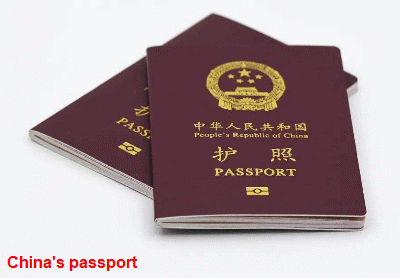
Since late 1990s, the government relaxed its rigorous control over the people, and ordinary people could apply for passports, travel or study abroad. Chuguo (出国, going abroad) became a common thing.
In addition, ordinary people could exchange RMBY (China's money) for up to 50,000 US dollars each year at local banks to pay for various expenses in overseas travel or study, especially the tuition fees.
Some rich families began to buy real estate of foreign countries in an "adding-up-money" way, for example, 50 grand from husband, 50 grand from wife, 50 grand from son, 50 grand from daughter, etc.
296
In the first decade of the 21st century, a large number of computer viruses appeared, and the most famous one was xiongmaoshaoxiang (熊猫烧香, the panda burning incense) which broke out in 2006.
This virus was produced and spread by a 24-year-old programmer. If your computer was infected with it, all executable files would be inexecutable, and their icons would become a panda burning incense.
As viruses appeared one after another, anti-virus software (shareware and freeware) also appeared one after another, and two popular and powerful tools were China's Kingsoft and Russia's Kaspersky.
After 2010, due to the enhancement of Windows security mechanism, viruses were getting less and less. Today, many people no longer use anti-virus software, they only use Windows' built-in Defender.



Comments